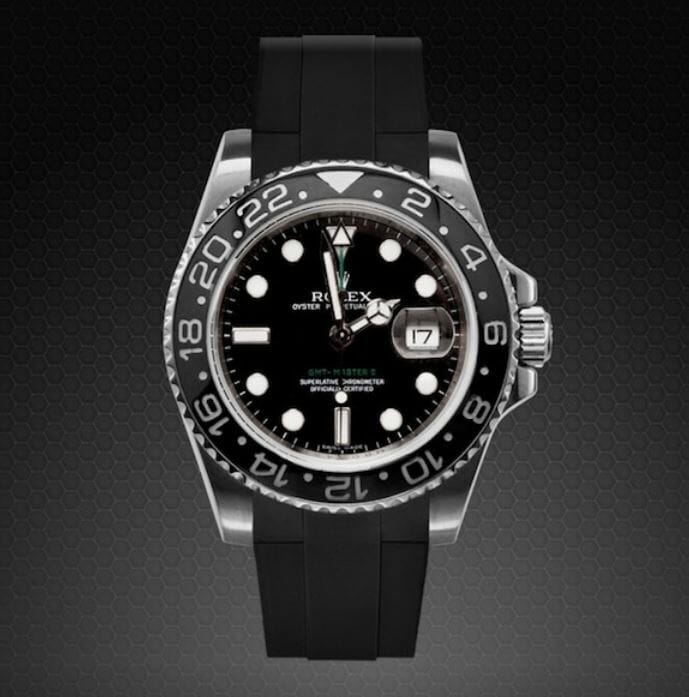
When it comes to servicing fine timepieces, there is nothing that delights a client more than receiving their freshly serviced timepiece back looking and operating as new as the day they bought it. One of the multitude of characteristics that make Rolexes so desirable is the attention to detail that the company invests in making certain that this “like new” condition can be achieved in after sales service. I have only encountered a small handful of other brands with which this same quality holds true across their entire offering. Armed with a small arsenal of refinishing techniques, it is a fairly straightforward task to bring most of the watches in Rolex’s portfolio back to factory fresh condition. Many of their models can be refinished with little more than a variable speed polishing lathe, a few hand tools, and a selection of buffs and compound. A select few, however, require a little extra attention. One such model is the Rolex Yacht-Master. In particular, the bezel of the Rolex Yacht-Master.
The Rolex Yacht-Master is the only model in the company’s current line-up that features any sort of sandblasted finish, all of which occurs on the bezel. If your shop is equipped with a sandblaster and polishing equipment, for a relatively small investment it is possible to fabricate a simple jig that will make the task of refinishing these bezels on-site quick and worry-free.
If access to a sandblaster is not possible, the best course of action is to send the bezel away to a Rolex service center for refinishing.
The Objective
Before describing the jig, it is important to define what it needs to accomplish. We can dissect the top, most visible, side of the bezel into three distinct areas or zones, as pictured below.

The first zone is the bezel rim, which is highly polished. The second zone makes up the bulk of the bezel’s surface area and is recessed down from the highly polished areas of the bezel; it features an even, sandblasted finish. The third zone is comprised of raised numerals and indices that protrude up from the sandblasted surface. Like the bezel rim, these numerals and indices are highly polished. In order to restore these surface finishes in after sales service, we need a way to quarantine each of these zones during refinishing, so as not to contaminate a polished area with a specular finish from sandblasting or vice versa. The objective of the jig described in this post is to protect the highly polished rim of the bezel during sandblasting. The numerals and indices will be dealt with after the sandblasting has been completed.
Making The Jig
A ready made version of the jig I am about to describe how to make is available from Rolex and comes in three sizes: 29, 35, & 40mm, which correspond to the case diameters that Rolex produces the Yacht-Master I in. These jigs can be ordered directly from Rolex, or you can make your own in a matter of minutes using standard ABS pipe fittings from your local hardware store. The 35 & 40mm bezels correspond conveniently well to 1 1/4” pipe adaptors. An insert for the jig can be fashioned to provide the necessary support for 29mm Yacht-Master bezels, and a full ABS cap can be used in lieu of the standard nut fitting where the opening is already too wide to adequately protect the bezel rim.

When selecting a pipe fitting for the 40mm bezel, I recommend bringing along a measuring caliper to ensure the opening in the nut is not too wide. The 1 1/4” fittings created by some companies fit perfectly, while others are too wide by vital fractions of a millimeter. If you cannot find a suitable nut, or simply want to play it safe, you can fabricate the protective cover of the jig from a full ABS cap, as suggested above.
The platinum bezel of the 44mm, white gold, Yacht-Master II is slightly too large for most standard household pipe fittings. There is little reason to be concerned about this, though. As this model was released in 2007, it will be several years before the Yacht-Master II begins coming in for routine service. Even when they do begin to come in for service, due to the advanced nature of the LiGa formed wheels that operate the countdown timer and the intricate nature of the bezel’s interaction with the movement to program the mechanical countdown timer, Rolex will want to ensure that the highest possible quality of service is performed. Unless you have been trained on servicing the Rolex 4160 caliber that is running under the hood of the Yacht-Master II, I highly recommend outsourcing the work to a Rolex service center – bezel and all.
Model Outer Diameter of Seating Diameter of Opening in Top
44mm 42.60mm 40.50mm
40mm 40.00mm 37.50mm
35mm 34.10mm 31.75mm
29mm 28.60mm 26.50mm
This article will focus on the 40mm Yacht-Master model. Jigs for other bezel sizes can be made by substituting the corresponding measurements from the table above into the steps below. To prepare the ABS fittings, follow these 7 simple steps:
Start by chucking up the threaded, male segment of a 1 1/4” ABS pipe fitting in your lathe.
Ensure that the fitting runs true and centered on the lathe, make any adjustments if necessary.
Cut a flat recess, 40mm in diameter, in the fitting, about 1mm deep. This will provide a seating to maintain the bezel’s position in the jig when the top is screwed down on it, as pictured below.

Screw the female segment (nut or cap) of the 1 1/4” ABS pipe fitting onto the male segment that is already on the lathe, to ensure the opening we will cut into it remains concentric with the seating we just prepared.
Cut a 45° recess into the fitting, the inner diameter of which should be 37.50mm. The 45° angle will help funnel the silica from the sandblaster onto the bezel.
Unscrew the female fitting and set the bezel in the first fitting that was cut and then screw the fitting you just cut down, finger tight, on top of it. Inspect the fit of the jig under a loupe and make any adjustments if necessary. The inner diameter of the screw down top should completely cover the outer rim of the bezel, without any gaps.mehr sehen
watch replica und
uhren rolex